

Thermal Insulation and Moisture: Two Major Challenges for Concrete and Brick Buildings
In many buildings, an underperforming building envelope causes a double discomfort: too much heat in summer and too much heat loss in winter, sometimes compounded by façade damage caused by moisture.
In Europe and North Africa alike, much of the building stock relies on concrete, brick or masonry block structures. These materials are strong, durable and well understood across the construction industry. But when they are not paired with a sufficiently high-performing thermal envelope, they can lead to two recurring problems: significant thermal discomfort and the gradual deterioration of façades due to moisture.
These issues are especially visible in older or poorly insulated buildings, but they also occur in some newer construction when design, installation or envelope protection choices are not suited to actual climate conditions.
Buildings That Are Too Hot in Summer and Too Cold in Winter
Concrete and brick should not be mistaken for insulating materials. They provide structural strength and thermal mass, but they still allow heat to flow through when no high-performance insulation layer is in place to limit that transfer. In summer, walls and especially roofs absorb a large amount of heat. In top-floor apartments, directly beneath a slab or roof that is heavily exposed to the sun, this heat can gradually be transferred to the interior.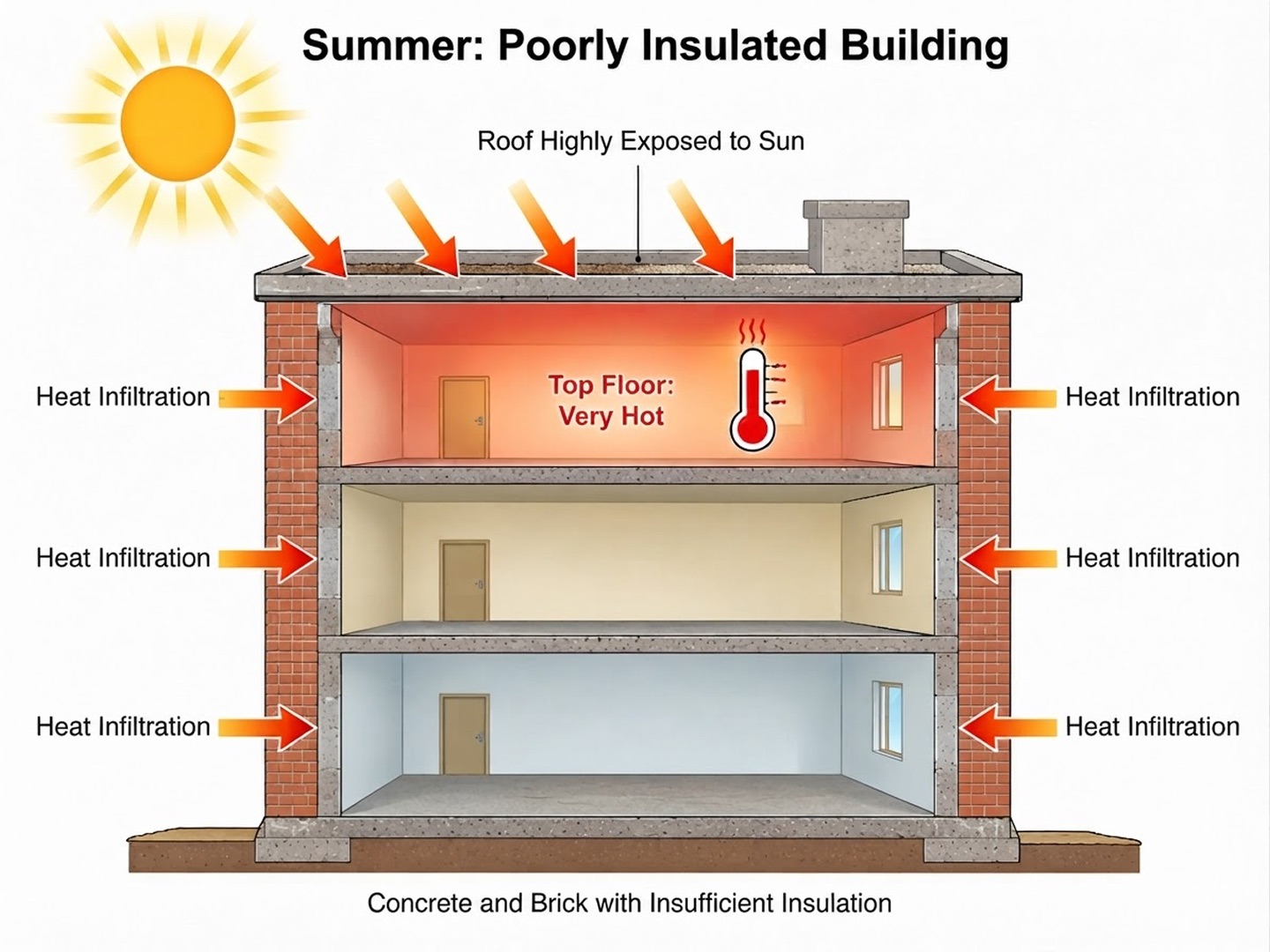
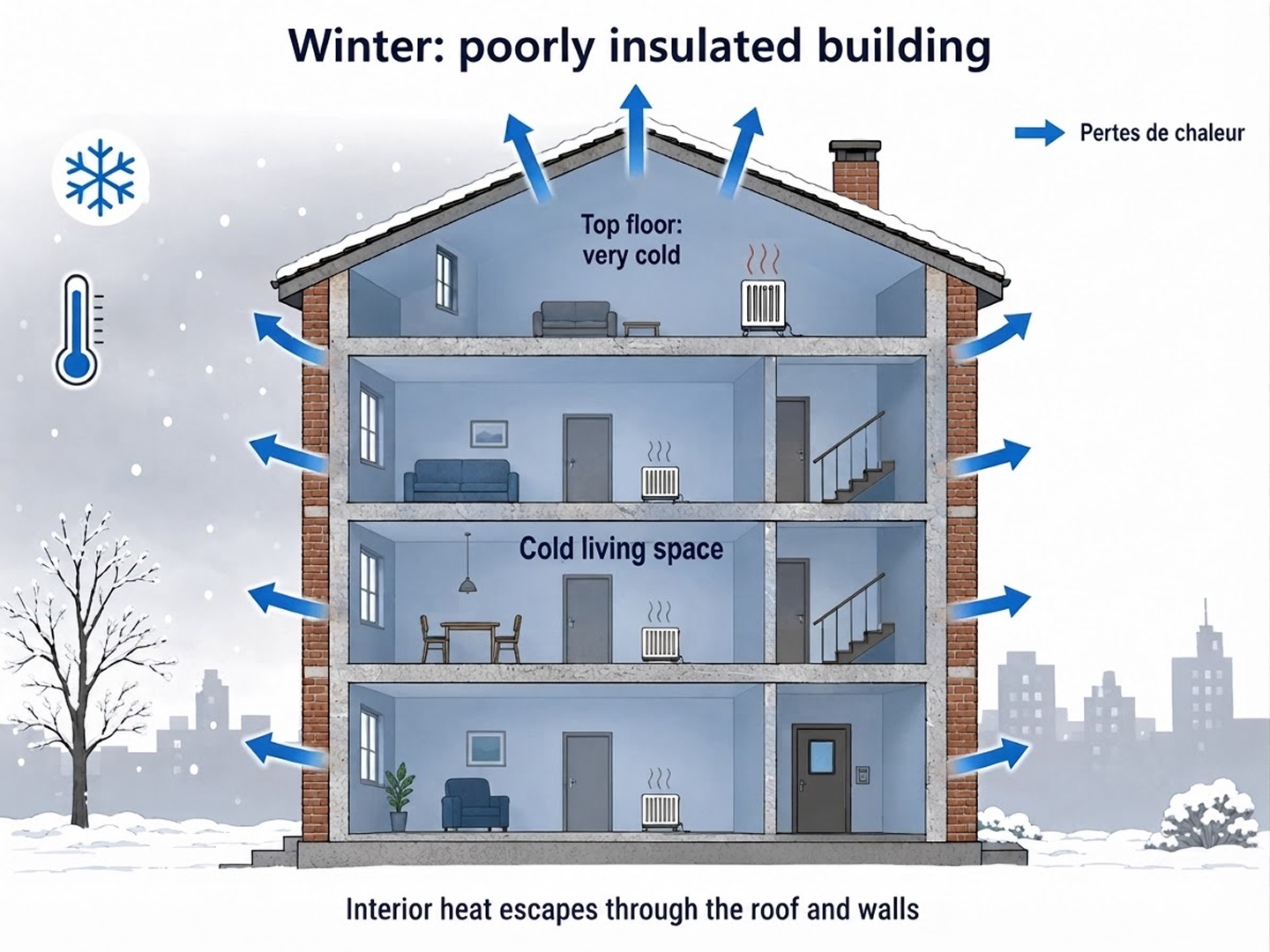
In summer, too much heat gets in; in winter, too much heat gets out.
Higher Energy Consumption
When the building envelope does a poor job of limiting heat exchange, heating and air conditioning systems must constantly compensate. The result is straightforward: higher energy consumption to maintain an acceptable indoor temperature. Improving the envelope therefore addresses the problem at its source. The goal is not simply to increase equipment capacity, but to reduce the amount of heat passing through walls and roofs.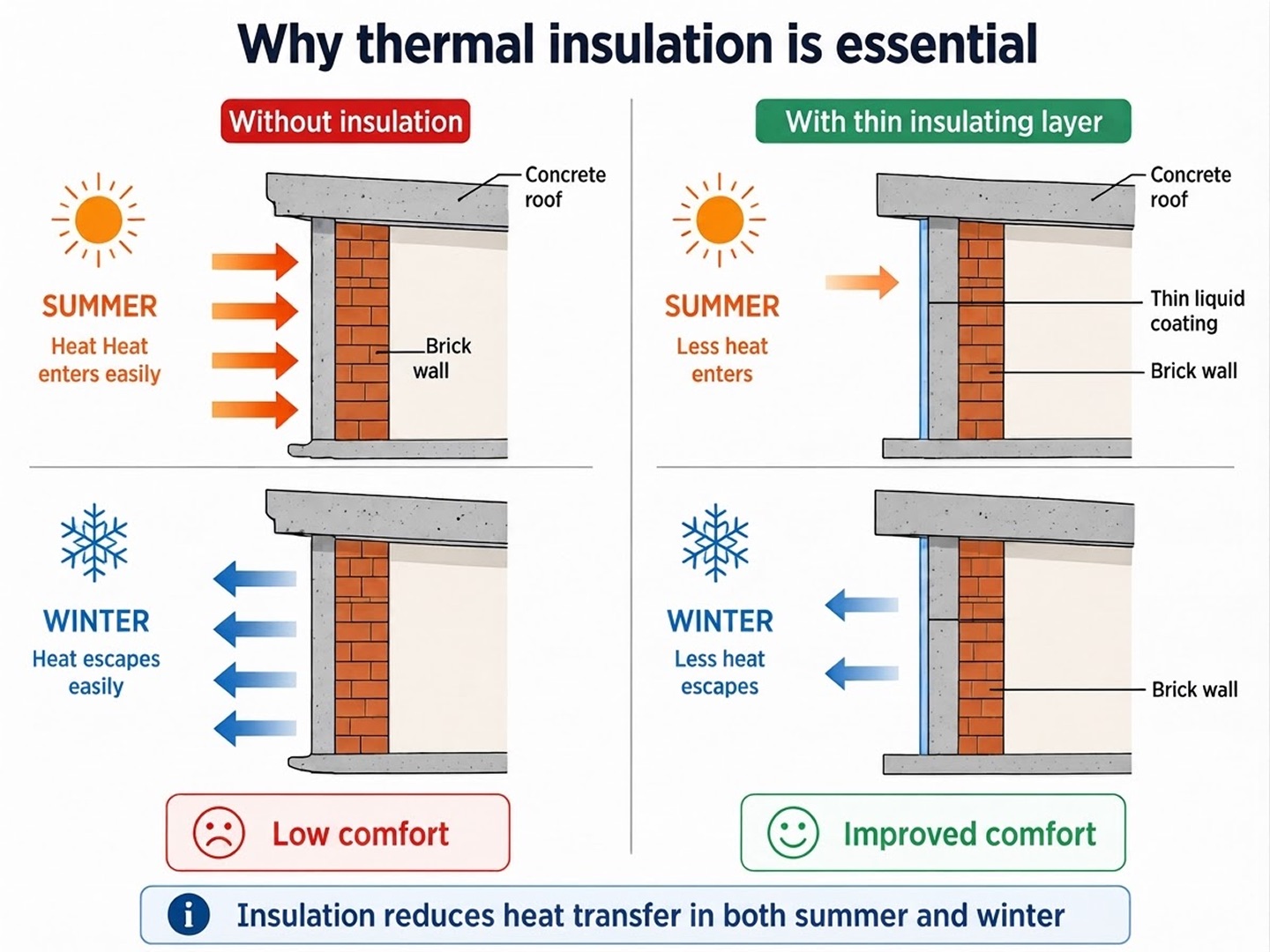
The Challenge of Retrofitting Existing Buildings
This issue is particularly significant for the existing building stock. In Europe, many buildings were constructed before modern energy requirements were introduced. In North Africa, concrete, brick and masonry block construction is widespread, with varying levels of thermal protection. In these buildings, adding conventional thick insulation can be complicated: limited space, architectural constraints, extensive work or high cost. This is where thin-film thermal protection solutions can be of interest, especially when they can be applied directly to existing surfaces.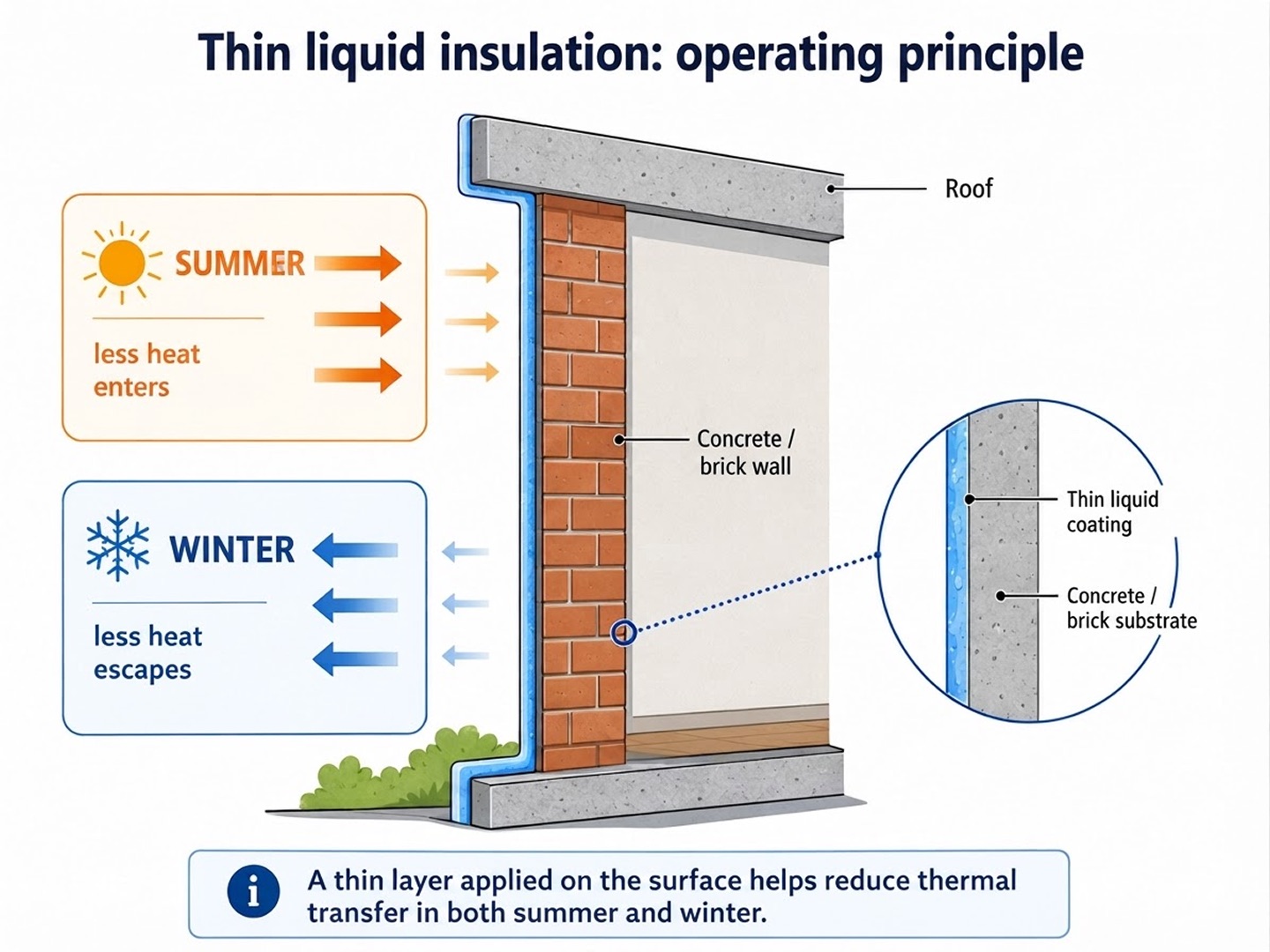
Moisture: The Other Enemy of Façades
However, a building’s performance does not depend solely on how well it manages heat. Walls and façades must also resist water and moisture. Two situations are particularly critical: buildings in coastal cities and periods of heavy rain. In coastal areas, façades are regularly exposed to high air humidity, salt spray and repeated wetting and drying cycles. During heavy rain, water can also penetrate cracks, deteriorated joints, porous stucco or plaster finishes, and areas with waterproofing defects.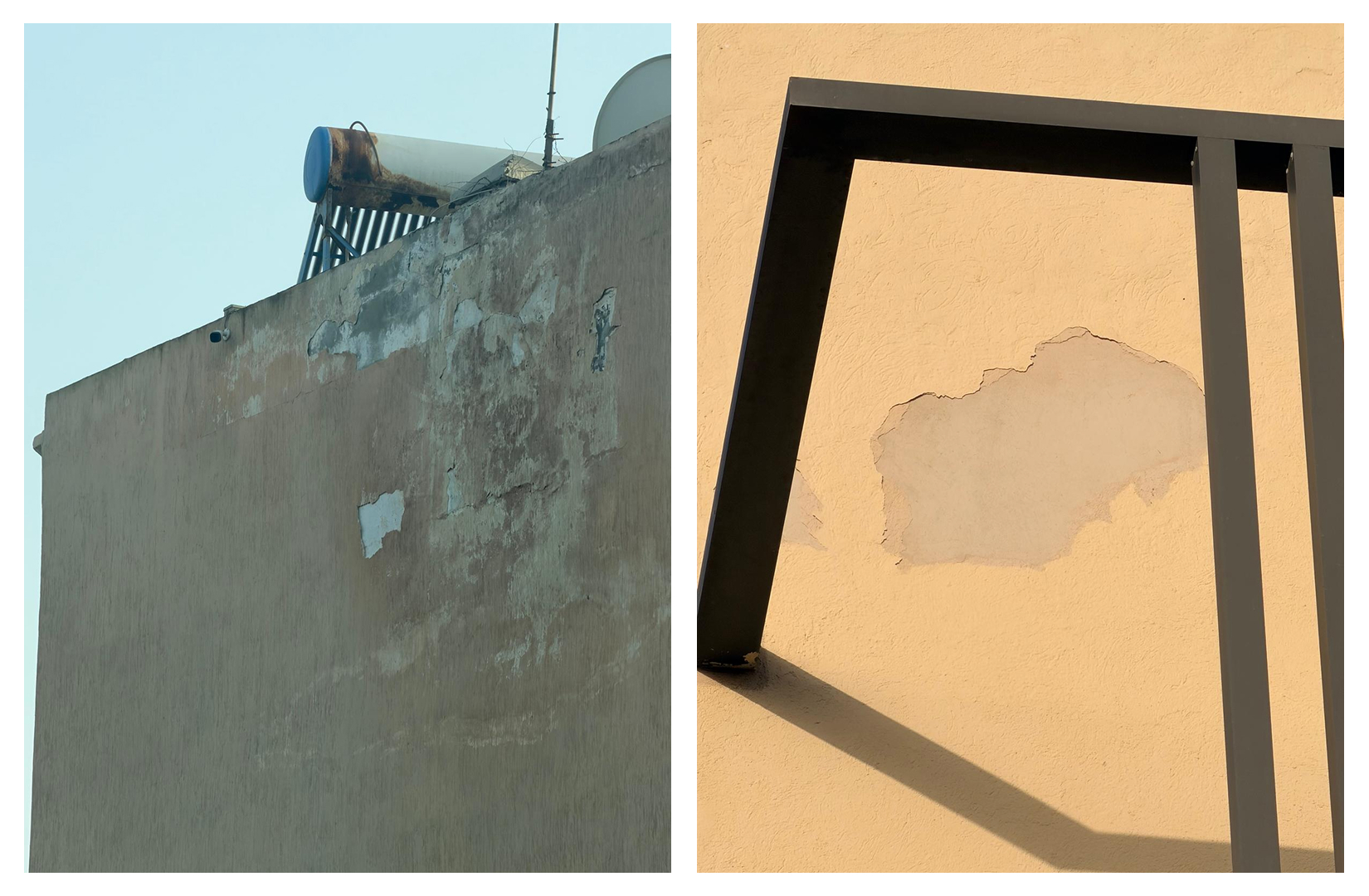
Blistering, Cracking and Peeling Paint
When moisture penetrates behind paint or a coating, its adhesion to the substrate can gradually weaken. Blisters may appear, and the paint may swell, crack and then flake off in sheets. In some cases, the stucco or plaster itself begins to break down. These defects are not merely cosmetic. They generally indicate that water is moving through, or trapped within, the wall assembly. In coastal cities, salts carried in the sea air can make the damage worse: they can enter materials along with moisture, then crystallize during drying phases and locally weaken stucco, plaster and coatings.Why Repainting Is Not Always Enough
When a façade shows blistering or peeling, the most common reaction is often to repaint. But if the source of the moisture is not addressed, the problem is likely to return. The first step is to identify where the water is coming from: infiltration after heavy rain, cracking, waterproofing defects, capillary rise, leaks or condensation. The substrate must then be able to dry properly before a new coating is applied. A good façade solution must therefore strike a balance between several functions: resisting liquid water, maintaining good adhesion and properly managing the water vapour present in the wall assembly.A High-Performing Envelope Must Manage Both Heat and Moisture
These various issues show that the building envelope must be treated as a complete system. It must limit heat transfer, protect against water penetration, withstand cycles of rain and drying, maintain good coating adhesion and allow for appropriate management of water vapour. For an exterior thin-film thermal solution, performance should therefore not be judged on thermal conductivity alone. Water resistance, vapour permeability, adhesion, crack resistance and durability are just as essential.Toward More Comfortable and More Durable Buildings
In Europe and North Africa alike, the challenge is no longer just to build solid buildings. It is also to design and retrofit envelopes that can maintain better indoor comfort year-round and withstand climatic stresses. Reducing heat gain in summer, limiting heat loss in winter, protecting façades from heavy rain and better managing moisture in coastal environments are complementary goals. In this context, developing thin, easy-to-apply thermal protection solutions suited to existing buildings is a particularly promising avenue, provided they simultaneously address the requirements for thermal performance, adhesion, water resistance and moisture management.
Fadwa Jemal, M.Sc. in Chemistry
Head of the R&D and Production Department
Head of the R&D and Production Department